
13
3 Advanced AMOLED Display Modules: Revolutionizing Ultra-Slim Hardware
AMOLED Display Modules are fundamentally shifting the paradigm of portable hardware design. For decades, hardware engineers developing laptops, portable monitors, and medical diagnostic equipment have been constrained by the physical limitations of traditional TFT LCDs. Because standard LCDs require a dedicated Backlight Unit (BLU)—including LED strips, light guide plates, and multiple diffuser films—there has always been a strict limit on how thin and light a screen could be manufactured.
Today, Active-Matrix Organic Light-Emitting Diode technology has shattered those physical barriers. By utilizing self-illuminating pixels, these advanced panels eliminate the entire backlight assembly, allowing hardware developers to achieve millimeter-level chassis thickness while simultaneously unlocking unprecedented visual fidelity. Below, we explore the engineering advantages of this technology and detail three cutting-edge display solutions from LCDind.
The Physics of True Black: Why AMOLED Display Modules Dominate
The core advantage of AMOLED technology lies in its individual pixel control. In a traditional IPS or TN panel, the backlight is “always on,” pushing light through a liquid crystal layer. Even when the screen attempts to display black, some light inevitably bleeds through, resulting in a glowing, dark grey appearance.
In contrast, AMOLED Display Modules utilize organic compounds that emit their own light when an electrical current is applied. When a section of the image is programmed to be black, those specific pixels completely power down. This absence of light generation creates a true “infinite” contrast ratio (often exceeding 100,000:1). This hardware characteristic is critical for premium laptops and portable monitors, ensuring zero light bleed and absolute color purity.
1. Flagship Precision: 15.6 Inch 4K UHD Module (ATNA56WR14)
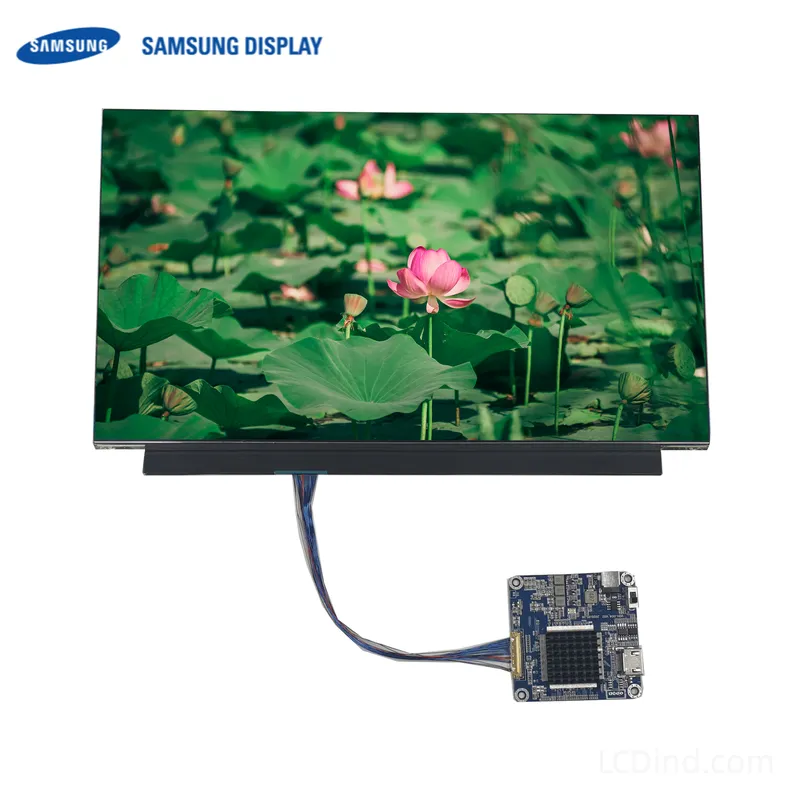
When developing flagship consumer electronics or high-end medical imaging stations, resolution and pixel density are paramount. The Samsung ATNA56WR14 module represents the absolute pinnacle of current display engineering. Utilizing an advanced LTPS (Low-Temperature Polycrystalline Silicon) TFT active matrix, it achieves a breathtaking 3840×2160 UHD resolution.
Because LTPS backplanes offer significantly higher electron mobility than standard amorphous silicon, this panel can drive a dense 4K pixel array while maintaining an incredibly thin physical profile of just 1.154 mm (Typ) and weighing a mere 200g. To resolve the complex signal timing required for 4K OLEDs, LCDind provides a comprehensive integration ecosystem, including a dedicated 12V HDMI to 40-pin eDP driver board kit.
Explore the hardware: 15.6 Inch 4K AMOLED Display | Samsung ATNA56WR14 UHD Kit
2. Power-Efficient Performance: 15.6 Inch FHD Module
While 4K displays are visually stunning, they place a massive rendering load on a device’s GPU and aggressively drain battery life. For hardware developers designing battery-powered portable monitors or ultra-lightweight laptops intended for all-day use, 1080p is often the superior engineering choice.
This 1920×1080 FHD module offers the exact same infinite contrast and true black capabilities as its 4K counterpart but requires a fraction of the processing power. Manufactured to strict RoHS compliance standards, this panel features an ultra-slim 1.35mm profile. It provides a strategic balance, giving your end-users professional-grade color accuracy without sacrificing device battery longevity.
Optimize your power budget: 15.6 Inch FHD AMOLED Display | 1920×1080 High Contrast Screen
3. Ultra-Lightweight Mobility: 13.3 Inch FHD Module (ATNA33XC11)
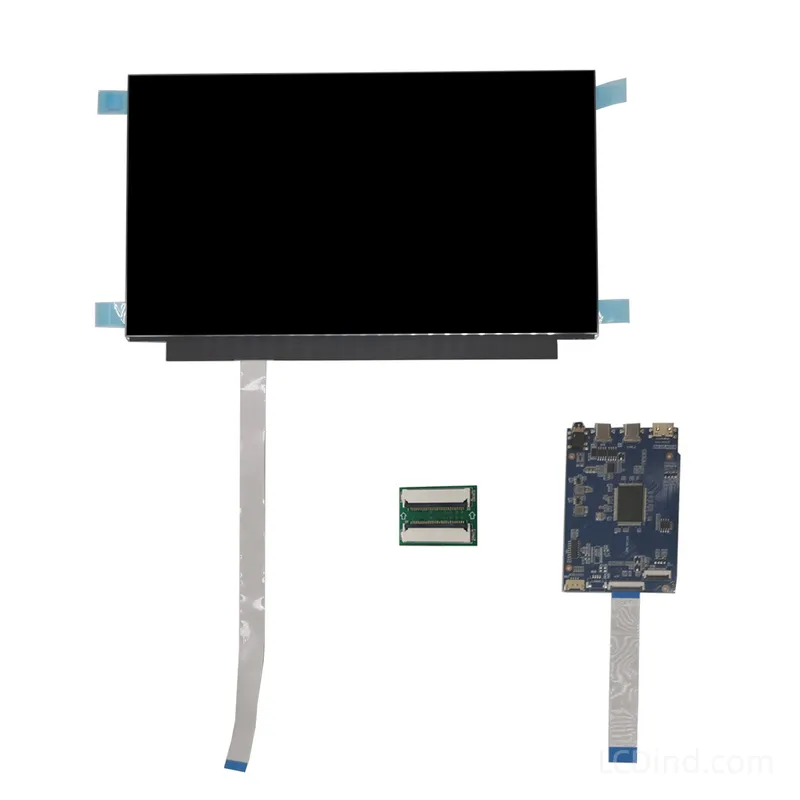
For ultimate portability in specialized hardware enclosures, scaling down the diagonal footprint yields significant mechanical benefits. The 13.3-inch Samsung ATNA33XC11 pushes the limits of lightweight engineering, tipping the scales at an astonishing 140g with a thickness of only 1.627 mm.
Beyond its physical dimensions, this panel is highly regarded for its ergonomic benefits. Because self-emitting OLEDs produce less high-energy blue light than standard LED backlights, it offers a “healthier” viewing experience, drastically reducing eye fatigue during prolonged use. Communicating natively via an eDP (V1.4b) interface, LCDind pairs this screen with a highly integrated driver board featuring both Mini HDMI and dual Type-C inputs for instantaneous plug-and-play prototyping.
Accelerate your ultra-slim design: 13.3 Inch FHD AMOLED Display | Samsung ATNA33XC11 eDP Panel
Engineering FAQ: Integrating AMOLED Screens
Q: Do these AMOLED Display Modules suffer from burn-in?
A: Historically, OLED technology was susceptible to image retention (burn-in) when displaying static UI elements. However, modern AMOLED Display Modules, like the Samsung panels listed above, utilize advanced pixel-shifting algorithms, dynamic brightness limiters (DBL), and superior organic materials to effectively mitigate degradation. For industrial applications, we recommend configuring your host OS to utilize screen sleep timers or dynamic interfaces to maximize panel lifespan.
Q: Why is an LTPS backplane used instead of a-Si (Amorphous Silicon)?
A: Driving millions of individual self-emitting diodes requires rapid electrical switching. LTPS (Low-Temperature Polycrystalline Silicon) provides up to 100 times the electron mobility of traditional a-Si backplanes. This allows for smaller driver circuits directly on the glass, which narrows the physical bezels, lowers power consumption, and is absolutely necessary to support the high pixel density of a 4K UHD AMOLED screen.
Q: Can I drive these panels directly from a Raspberry Pi or Mini PC?
A: The raw panels communicate via high-bandwidth eDP (Embedded DisplayPort) signals. A standard Raspberry Pi or Mini PC outputs HDMI. To bridge this gap, LCDind provides custom-matched controller boards (included with our ATNA56WR14 and ATNA33XC11 kits) that actively translate your host’s HDMI or Type-C signal into the exact eDP timing required to drive the display flawlessly.
Evidence & Documentation Status
- Public on this page: this article discusses AMOLED module selection for ultra-slim equipment where backlight thickness, contrast, power behavior and optical appearance are design factors.
- Available for engineering review: LCDind can check the AMOLED size, resolution, interface, FPC layout, cover lens, bonding method, brightness requirement and lifetime constraints against a defined hardware platform.
- Not claimed without supporting records: no universal lifetime, burn-in resistance, automotive qualification, medical qualification or customer-system compatibility is asserted without model-level documents and validation data.
Buyers should share the target enclosure thickness, display duty cycle, UI static-content risk, host interface, optical stack and forecast quantity before requesting AMOLED samples for an OEM device.