
13
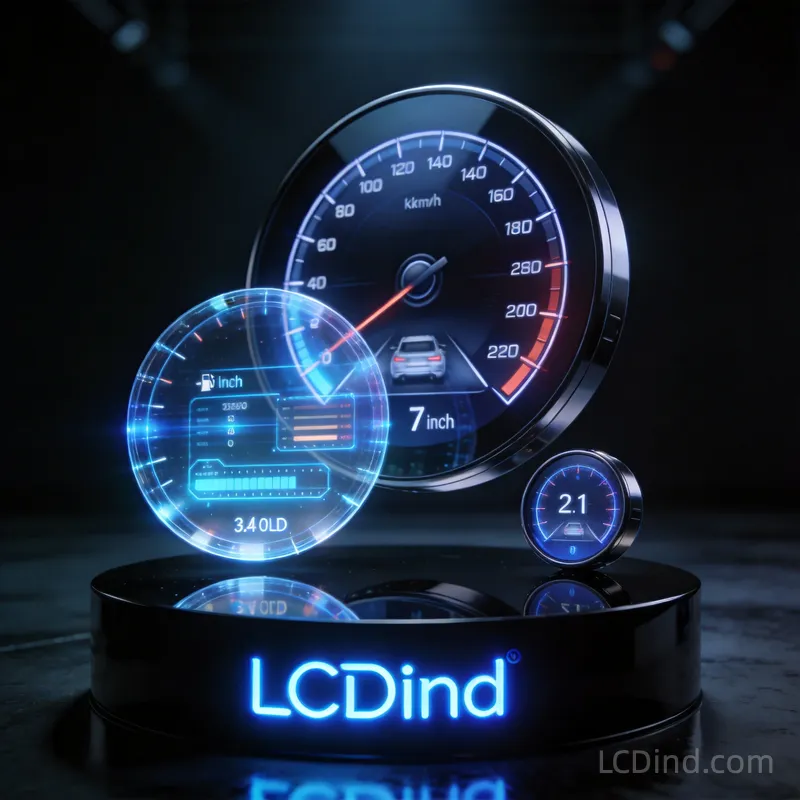
Round LCD Displays are fundamentally reshaping how industrial designers and hardware engineers approach user interfaces. For decades, digital readouts were strictly confined to rectangular boundaries, forcing compromises in the aesthetic design of rotary knobs, vehicle dashboards, and wearable technology. Today, native circular monitors eliminate those dead corners, allowing digital data to flow seamlessly within naturally cylindrical or spherical enclosures.
Whether you are developing a futuristic EV center console, a holographic AR headset, or a high-fidelity flight simulator, selecting the precise circular module is critical for your hardware ecosystem. Below, we break down three cutting-edge circular screen solutions engineered by LCDind to push the boundaries of modern UI design.
1. The Command Center: 7 Inch 1080×1080 IPS Module
When designing central control hubs for luxury smart homes or replacing the iconic center-dash circular infotainment systems in automotive applications, size and viewing angle dictate user experience. A massive 7-inch circular active area provides an unbroken digital canvas for intricate navigation maps, rotating dials, and high-definition video.
By utilizing an advanced IPS (In-Plane Switching) architecture and a dense 1080×1080 pixel matrix, this module ensures that contrast and color saturation remain entirely consistent from extreme top, bottom, or side angles. Operating natively via a high-speed 30-Pin RGB interface, it integrates directly into proprietary ARM processors. For rapid prototyping, developers can utilize an optional HDMI driver board kit for instant plug-and-play video signal conversion.
Explore the hardware: 7 Inch Round LCD Display | 1080×1080 IPS RGB Interface Module
2. Holographic Integration: 3.4 Inch Transparent OLED
Augmented Reality (AR) optics, Heads-Up Displays (HUD), and premium holographic wearables require displays that overlay digital intelligence directly onto the real world without obstructing vision. This is where transparent OLED (TOLED) technology dominates.
Unlike standard LCDs, an Active-Matrix Organic Light-Emitting Diode architecture eliminates the need for bulky backlight units. Because OLED pixels are self-illuminating, pixels programmed to display “black” physically turn off. This complete absence of light generation renders those pixels entirely transparent to the naked eye. The result is an infinite contrast ratio where glowing data, gauges, and animations appear to float in mid-air inside a completely clear 3.4-inch circular glass profile.
Step into the future: 3.4 Inch Transparent OLED | Round Circular Monitor Screen
3. Micro-Precision: 2.1 Inch 480×480 RGB Screen
Compact smart home rotary knobs, PC AIO liquid cooler screens, and custom e-bike digital speedometers require ultra-high-definition rendering within a highly constrained physical footprint. A 2.1-inch round screen serves as the perfect visual core for these applications.
Packing an immense 480×480 resolution into a 53.28×53.28 mm active area, this module eliminates voxel distortion on complex graphical interfaces. It is heavily utilized by the aviation and racing simulator communities to recreate highly accurate digital tachometers, altimeters, and artificial horizons with hyper-realistic movement. Capable of withstanding extreme temperatures from -20°C to 70°C, it delivers industrial reliability alongside a vibrant RGB communication interface.
Build custom gauges: 2.1 Inch Round LCD Display | 480×480 RGB Flight Simulator Screen
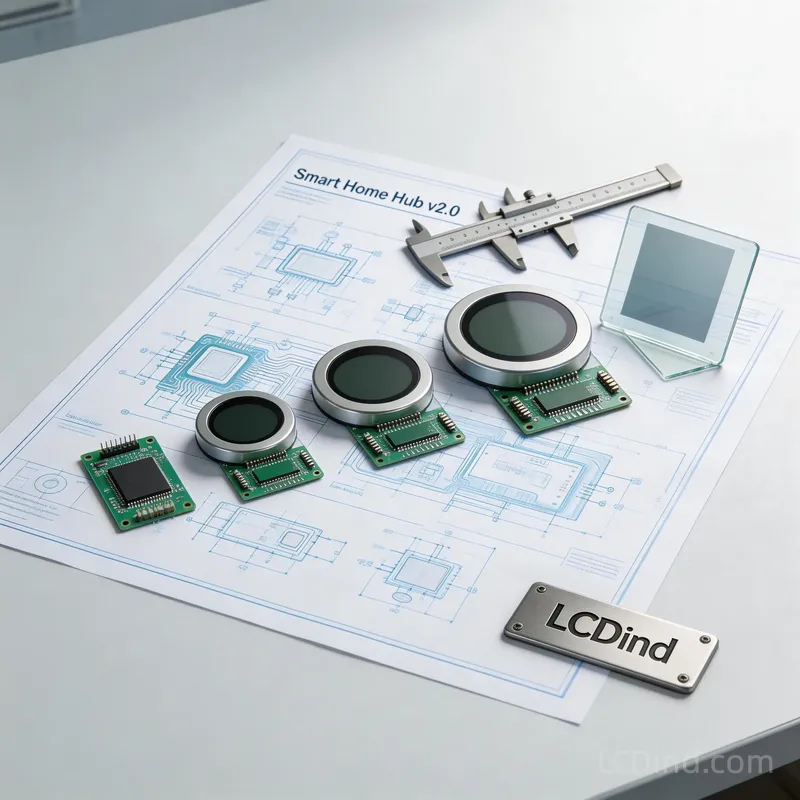
Choosing the Right Circular Display for Your Project
Integrating a circular screen is no longer a niche hardware modification; it is a vital strategy for premium product differentiation. From heavy-duty automotive dashboards to invisible AR HUDs, LCDind provides the precise optical hardware and controller board kits to accelerate your development cycle. If your project requires custom FPC shapes, specific touch panel bonding, or bespoke interface definitions, our engineering team is ready to assist.
Engineering FAQ: Integrating Circular Displays
Q: How do I output a standard UI (like Windows or Raspberry Pi OS) to a round screen?
A: From a software and hardware processing perspective, the motherboard actually treats a round display as a standard square monitor (e.g., 1080×1080 or 480×480). The physical LCD panel simply masks the corners. To create a seamless circular interface, you must design your software UI with a pure black background in the four corners, ensuring all interactive elements, dials, and text remain strictly within the central circular boundary.
Q: What is the primary difference between a Round TFT LCD and a Round Transparent OLED?
A: The core difference is the light source. A Round TFT LCD requires a backlight module shining through liquid crystals, making the entire panel opaque. It is incredibly bright and highly durable, perfect for automotive and smart home hubs. A Transparent OLED features self-emitting pixels with no backlight. When pixels are turned off (displaying black), they become physically see-through, making OLEDs the only choice for Augmented Reality and Heads-Up Displays (HUD).
Q: Can I add touch functionality to these circular monitors?
A: Absolutely. While raw panels are often non-touch, adding a Capacitive Touch Panel (CTP) is a standard industry upgrade. A custom-cut circular touch digitizer can be optically bonded to the surface of the display. This is highly recommended for smart home central hubs and interactive rotary knobs where user input is required.
Choosing the Right Circular Display for Your Project
Integrating a circular screen is no longer a niche hardware modification; it is a vital strategy for premium product differentiation. From heavy-duty automotive dashboards to invisible AR HUDs, LCDind provides the precise optical hardware and controller board kits to accelerate your development cycle. If your project requires custom FPC shapes, specific touch panel bonding, or bespoke interface definitions, our engineering team is ready to assist.
Evidence & Documentation Status
- Public on this page: the article discusses round LCD and circular display use cases for smart hubs, control dials, vehicle UI concepts and compact equipment interfaces.
- Available for model review: LCDind can check round active area, square-to-round mask design, MIPI or other host interface, cover lens shape, optical bonding, touch requirement and mounting tolerance against a selected module.
- Not claimed without supporting records: no statement on universal automotive approval, all-angle sunlight readability, or mechanical interchangeability should be treated as confirmed without a controlled drawing and validation result.
For quotation, provide the required visible diameter, interface, cover shape, touch requirement, UI orientation, enclosure constraints, brightness target and production forecast.